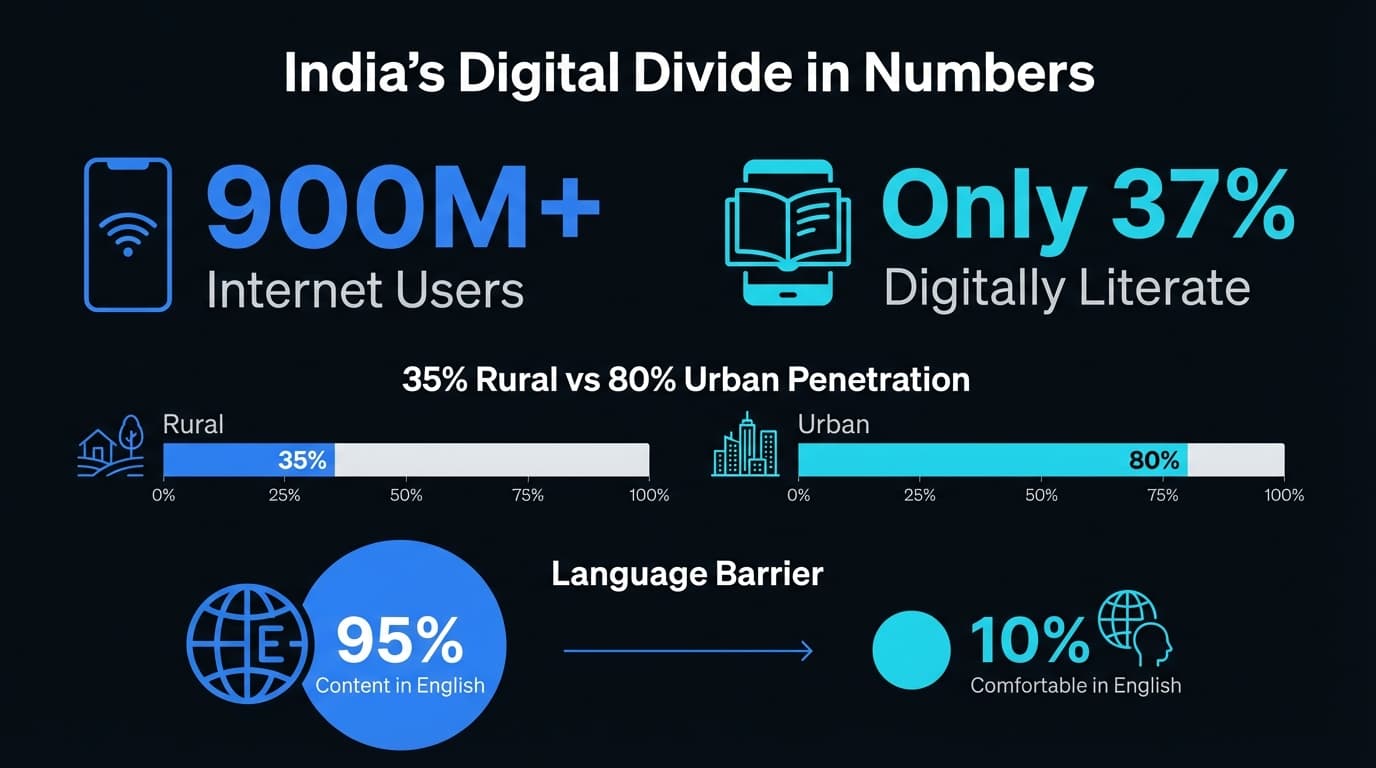
India crossed 900 million internet users in 2025. On paper, that number sounds like a digital revolution. In reality, it masks a deep structural problem — the state of digital literacy in India remains alarmingly low. According to NASSCOM Foundation, only 37% of Indians are digitally literate. That means roughly 63% of the population can access the internet but cannot use it productively for education, livelihood, or civic participation.
This article examines why access alone has failed to create adoption, what UPI's success teaches us about mass-scale digital behaviour change, and how AI — particularly voice-first, vernacular AI — is emerging as the most realistic bridge across India's digital divide.
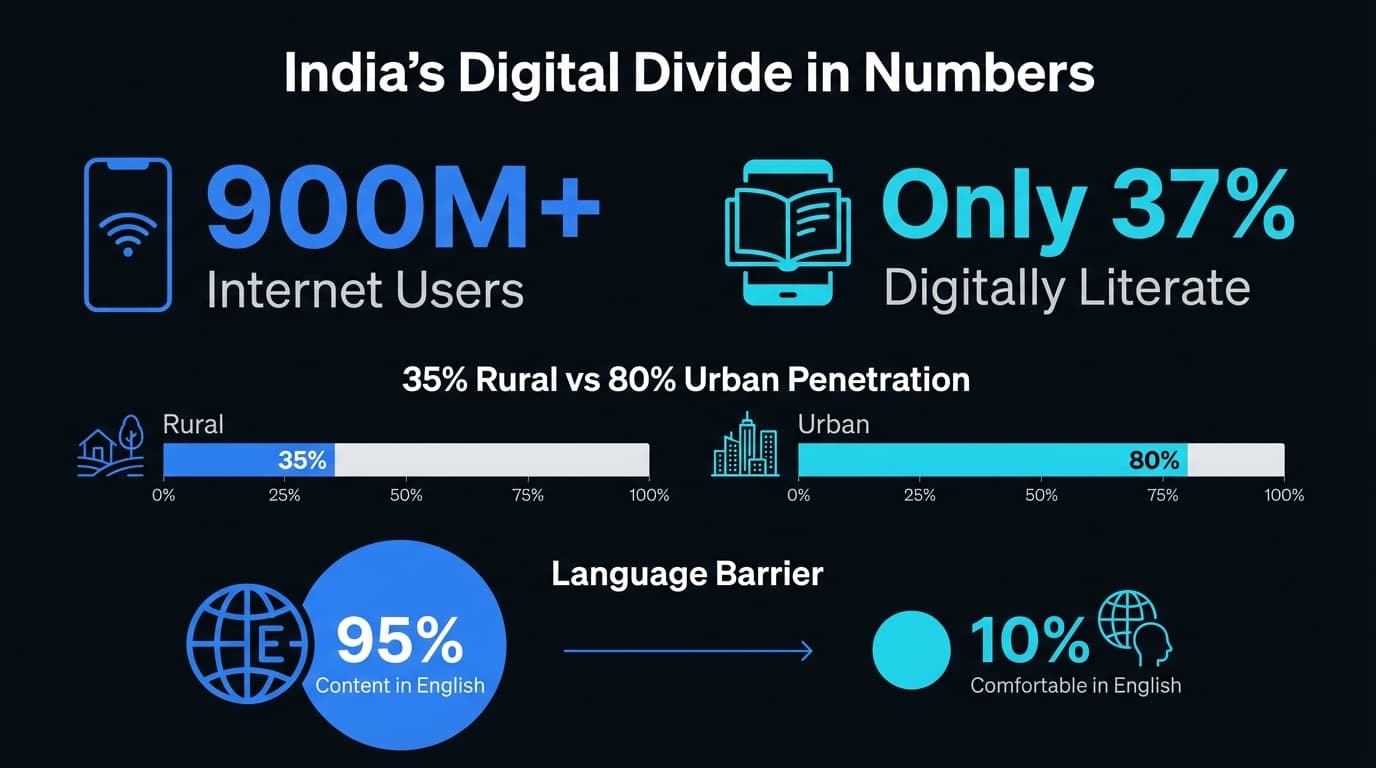 Digital literacy in India statistics showing 900 million internet users but only 37 percent digitally literate
India's Digital Paradox — 900 Million Online, 63% Still Digitally Illiterate
The numbers tell a contradictory story. TRAI data shows India had over 100 crore internet subscribers by mid-2025. Smartphone penetration sits between 659 and 740 million active devices, according to Business Standard. Yet only 38% of Indian households qualify as digitally literate, with a sharp urban-rural split — 61% in urban areas versus just 25% in rural India, as per NIELIT estimates.
There is a critical difference between having internet access and knowing how to use it. Millions of Indians can open YouTube or scroll WhatsApp. However, the same users struggle to fill a government form online, apply for a scheme through a portal, or compare prices on an e-commerce site. This is the "digital confidence gap" — basic consumption works, but productive digital engagement does not.
The barriers are well documented. A CEDA/Ashoka University study found that 50% of rural and 40% of urban offline households cited low digital readiness as the primary reason for staying offline. Additionally, 20% lacked basic digital skills, 17% had no device, and 16% pointed to affordability. Social restrictions affect 20% of non-users, especially women — where mobile ownership sits at 56% compared to 84% for men, according to NSS Survey data published by PIB.
Infrastructure gaps compound the problem. Rural internet penetration hovers at 35-37%, compared to 70-88% in Tier-1 cities. Fiber connectivity reaches 15.3% of urban households but only 3.8% of rural ones. Even where connectivity exists, the quality gap limits what users can actually do.
Why 90% of Indians Cannot Use the English-Only Internet
The language barrier is perhaps the most underestimated obstacle to digital literacy in India. Consider this: 95% of internet content worldwide is in English. Only 10% of Indians are comfortable using English. India has 22 official languages and over 19,500 dialects. The mismatch is staggering.
Research backs this up with hard data. Over 70% of Indian internet users prefer content in their regional language. A Microsoft study found that users are 2.5 times more likely to trust and engage with apps in their mother tongue. More than 50% of Google Discover content consumed in India is already in Indian languages. Furthermore, one-third of Google Assistant users in India interact in an Indian language rather than English.
Think about what this means practically. A farmer in Madhya Pradesh tries to check crop prices on a government portal — the interface is in English. A woman in Tamil Nadu wants to apply for a welfare scheme online — the form fields are in English. A small shopkeeper in Odisha tries to register for GST — every instruction is in English. Each of these moments is a failure point where potential digital adoption dies.
This is not a literacy problem in the traditional sense. Many of these users are literate in their own language. They simply cannot navigate digital systems built by English-speaking engineers for English-speaking users. Until products meet users in their own language, digital literacy in India will remain artificially suppressed.
At Call O Buzz, we see this gap as a design failure, not a user failure. Building vernacular AI solutions that work in Indian languages is central to our approach.
The UPI Blueprint — What India's Payment Revolution Teaches About Digital Literacy
If someone tells you mass digital adoption is impossible in India, point them to UPI. The Unified Payments Interface processed 228 billion transactions in 2025, worth approximately Rs 300 trillion. India now handles 49% of the world's real-time digital transactions, according to PIB.
UPI went from near-zero to commanding 83% of all Indian payments in under eight years. That is the fastest adoption curve of any financial technology globally. In December 2025 alone, UPI recorded 21.63 billion transactions worth Rs 27.97 trillion.
Here is the data point that should make every product builder reconsider their assumptions: rural youth aged 15-24 show UPI adoption at 86.7% — actually higher than urban youth at 74.4%, according to The Secretariat. Small-town digital payments reached 50% share in FY25, up from 42% the previous year.
| UPI Milestone | Value | Year |
|---|---|---|
| Annual transactions | 228 billion | 2025 |
| Transaction value | ~Rs 300 trillion | 2025 |
| Share of total payments | 83% | End 2024 |
| Global real-time share | 49% worldwide | 2025 |
| Rural youth adoption (15-24) | 86.7% | 2025 |
| Monthly record | 21.63B transactions | Dec 2025 |
| International reach | 7+ countries | 2025 |
Why did UPI succeed where so many digital initiatives struggled? Several factors stand out:
- Zero merchant charges — removed the economic friction entirely
- QR code simplicity — no complex interfaces, no forms, no English required
- Public-private synergy — NPCI worked with PhonePe, Google Pay, and Paytm simultaneously
- UPI 123PAY — feature phone payments via IVR in 12 Indian languages, without internet
- Network effects — once your chai seller accepted UPI, everyone adopted it
The core lesson from UPI is clear: Indians adopt digital tools rapidly when the design meets them where they are. UPI worked because it eliminated complexity, not because it educated users to handle complexity.
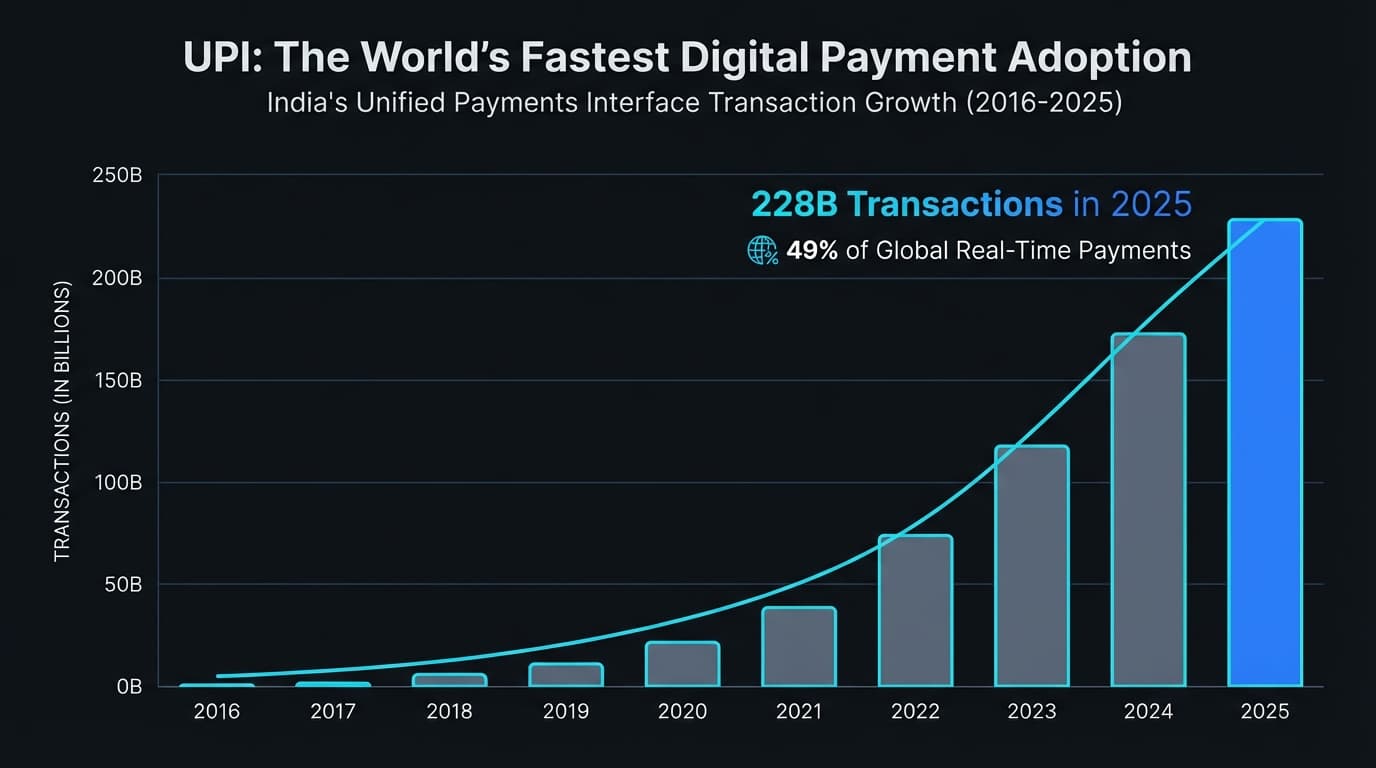 UPI transaction growth chart showing India's digital adoption from 2016 to 2025
From JAM Trinity to AI Stack — How India Built the Infrastructure for Digital Inclusion
India's digital infrastructure story over the past decade is genuinely impressive. The JAM trinity — Jan Dhan, Aadhaar, Mobile — created the rails on which digital services could travel. Now, AI is adding intelligence to those rails.
Aadhaar covers 141.88 crore Indians as of April 2025 — nearly universal identity coverage. Jan Dhan opened 55-56 crore bank accounts, bringing financial access to hundreds of millions who had never entered a bank. DigiLocker serves 51.6 crore users with 943 crore documents stored digitally. The UMANG app offers 2,300+ government services to 82 million users.
Direct Benefit Transfer (DBT) represents the sharpest proof that this infrastructure works. The government has disbursed Rs 44 lakh crore cumulatively through DBT, saving Rs 3.48 lakh crore by eliminating leakage. Notably, 5.87 crore fake ration cards were removed from the system.
On the connectivity side, BharatNet has connected 2.14 lakh Gram Panchayats. 5G coverage reached 99.6% of Indian districts within just 22 months of launch, spanning 4.74 lakh towers. Data costs dropped from Rs 308 per GB in 2014 to Rs 9.34 per GB in 2022, according to PIB data. Indian users now consume 27.5 to 36 GB of data per month.
However, there is a clear pattern here. Infrastructure has succeeded, but digital capability has lagged behind. The government's PMGDISHA programme trained 6.39 crore candidates (against a target of 6 crore) and certified 4.78 crore. These are substantial numbers. Still, the gap between enrolment and real-world digital confidence remains wide. Training people to use specific apps is different from building genuine digital fluency.
This is precisely where AI enters the picture. Rather than training 900 million people to navigate English-language interfaces, AI can translate, simplify, and voice-enable those interfaces. The infrastructure is ready. The intelligence layer is now being built. At Call O Buzz, we believe the next phase of India's digital story will run on AI, not just on fiber and towers.
How AI Is Breaking India's Language Barrier — Bhashini, Sarvam AI, and BharatGen
The most meaningful AI developments for digital literacy in India are not coming from Silicon Valley. They are being built specifically for Indian languages, Indian contexts, and Indian users.
Bhashini — India's Government AI Translation Platform
Bhashini is the government's flagship AI translation initiative and it has scaled remarkably fast. The platform supports 35+ Indian languages through 1,600+ AI models. It has processed over 5 billion inferences and handles 8-10 million daily translation calls.
What makes Bhashini significant is its integration reach. It is connected to 47 government portals, including IRCTC for railway bookings, NPCI's IVRS system for payment queries, and Lok Sabha and Rajya Sabha proceedings. Over 50 collaborators — including NPCI and the RBI Innovation Hub — contribute to the ecosystem. Essentially, Bhashini is turning English-only government services into multilingual ones, and it is doing this at genuine scale.
Sarvam AI — India's Foundational AI Company
Sarvam AI represents the private sector's most ambitious bet on Indian-language AI. The company has raised $53.8 million from investors including Lightspeed, Peak XV Partners, and Khosla Ventures. Their models handle voice commands across 22 Indian languages.
The most interesting product in their lineup is Sarvam Edge — on-device AI that runs entirely offline without any cloud dependency. For rural India, where connectivity is intermittent, this is transformative. Sarvam also signed an MoU with Tamil Nadu to establish India's first Sovereign AI Park at an investment of Rs 10,000 crore. Furthermore, India's IT Ministry selected Sarvam to build India's first indigenous foundational model under the IndiaAI Mission.
BharatGen and Krutrim — The Broader Indian AI Ecosystem
The ecosystem extends well beyond single players. BharatGen's Param 2 is a 17-billion parameter Mixture-of-Experts model built for 22 Indian languages, developed by an IIT Bombay consortium with NVIDIA's support. The model is available openly on HuggingFace.
Krutrim, founded by Ola's Bhavish Aggarwal, has raised $74 million and is building indigenous language models alongside ambitious plans for AI chips manufactured in India. Google has launched AI Mode in 7 Indian languages and committed $4 million+ for Indic language research, including $2 million for IIT Bombay's Indic Language Hub and $2 million for Wadhwani AI's Garuda project. Meta and Reliance's joint venture has invested Rs 8.55 billion for a Llama-based enterprise AI platform targeting Indian businesses.
The IndiaAI Mission — backed by Rs 10,371.92 crore over five years and provisioning 34,000+ GPUs — signals that AI for Indian languages is now a national priority, not just a startup experiment.
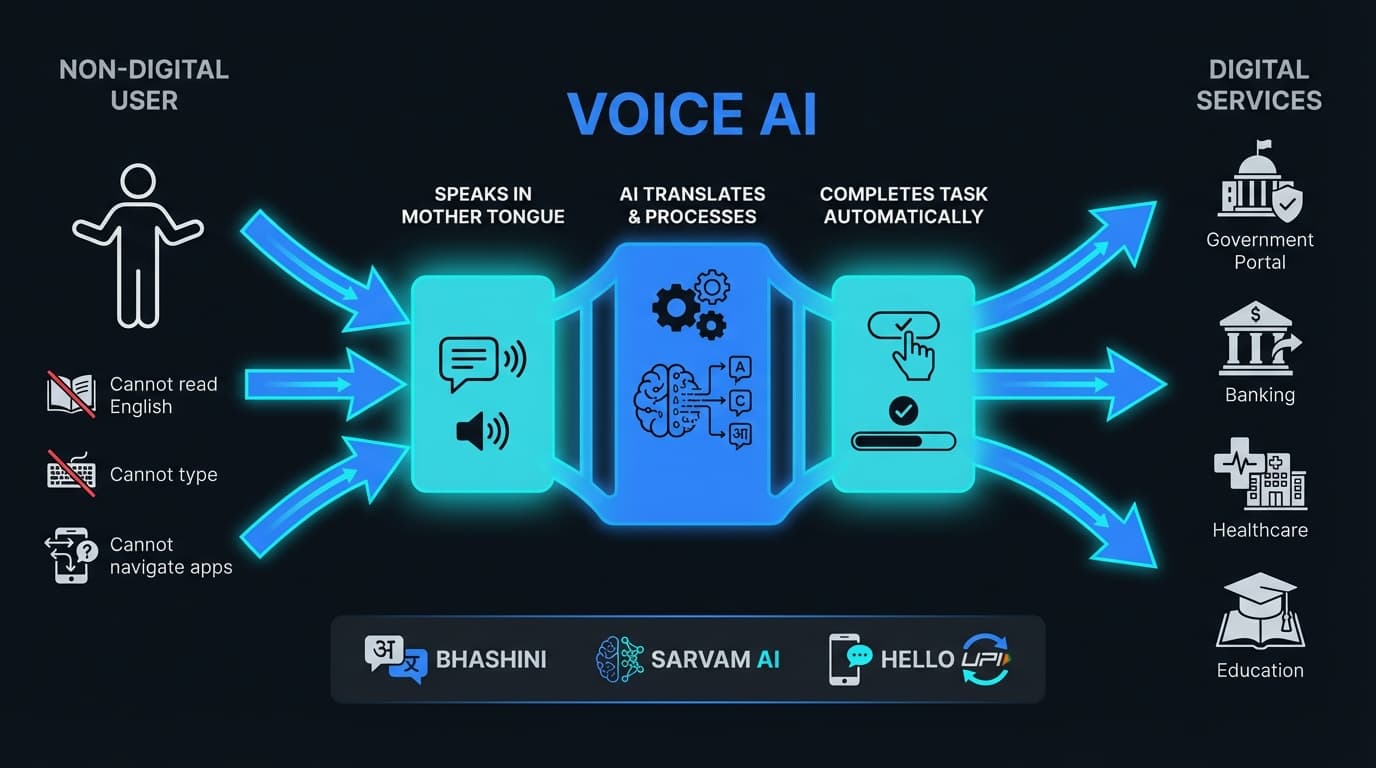 How voice-first AI bridges the digital literacy gap in India for non-English speakers
Voice-First India — Why the Future of Digital Literacy Is Spoken, Not Typed
Voice technology is the single most impactful tool for bridging digital literacy in India. The reason is simple: voice removes the reading and typing barrier, which is the biggest blocker for digitally illiterate users.
India's voice AI market stands at USD 153 million in 2024 and is projected to reach USD 957.6 million by 2030, growing at a 35.7% CAGR. This growth is driven by genuine user need, not just technological novelty.
Think about what voice-first AI means practically. A farmer who cannot read English can ask a WhatsApp bot in Hindi about today's mandi prices. A rural health worker can get AI-powered diagnostic guidance in Telugu through a voice call. A small business owner can file a GST return by speaking to an AI assistant in Marathi. Each of these scenarios takes a 10-step digital process and compresses it into a single voice command.
Specific products already demonstrate this shift:
- Hello UPI by NPCI enables voice-activated payments
- WhatsApp bots from multiple state governments deliver scheme information in local languages
- Voice-based agriculture advisory services operate in 12+ languages across several states
- AI-powered health consultations in vernacular languages serve primary healthcare workers
The key insight is that voice-first design does not just accommodate illiterate users — it is actually faster and more natural for everyone. Even digitally literate Indians increasingly prefer voice interaction for tasks like search, navigation, and messaging.
For product builders, the implication is clear. If you are building for India's next 500 million users, voice-first is not a nice-to-have feature. It is the primary interface. At Call O Buzz, our AI-powered SaaS products are designed with this principle at the core — voice-first, vernacular-default, and built for real Indian users.
What Product Builders Get Wrong About Digital Inclusion in India
Most technology products in India are built by digitally fluent, English-speaking engineers working from Bangalore or Hyderabad. This creates a persistent blind spot. The product builder's daily experience is nothing like the end user's reality.
Here are the most common mistakes:
Assuming smartphone equals digital capability. India has 800 million+ smartphones, but only 37% of users are digitally literate. Owning a device is not the same as knowing how to use it effectively. Product dashboards show "mobile users" and teams celebrate — without realising most of those users cannot complete core tasks.
Over-engineering when simplicity wins. UPI proved that stripping features down, not piling them up, drives adoption. Every additional screen, every extra form field, every toggle switch reduces the pool of users who can complete the flow. Simplicity is not a compromise — it is the strategy.
Ignoring offline-first and low-bandwidth constraints. Most product teams test on 100 Mbps office Wi-Fi. Their actual users operate on 2G-equivalent connections in areas where fiber reaches only 3.8% of households. Products must work on 256 kbps connections and survive intermittent connectivity drops.
Neglecting trust and safety. Digital fraud is actively eroding adoption. India reported Rs 228.45 billion in digital fraud losses in 2024, and UPI fraud specifically rose 85%. Users who get scammed once often abandon digital tools entirely. Building digital literacy in India requires addressing trust as aggressively as usability.
Building for "users like us." The tech bubble is real. Engineers use English, prefer typed interfaces, and have high-speed internet. They unconsciously design for themselves. Breaking this pattern requires deliberate research, vernacular testing, and spending time with actual users in Tier-3 cities and villages.
At Call O Buzz, we design for real users — voice-first interfaces, vernacular defaults, offline capability, and zero-learning-curve interactions. Our approach draws directly from what UPI's success taught the industry.
The Trillion-Dollar Opportunity — Building for India's Next 500 Million Users
The economic case for solving digital literacy in India is enormous. India's digital economy contributed 13.42% of GDP in 2024-25. That share is projected to reach 20% by 2030, making the digital economy worth over USD 1 trillion. By then, it will surpass both agriculture and manufacturing in economic contribution.
India already ranks second globally in AI adoption at 57%, just behind China at 58% and well ahead of the United States at 25%. There are 8,178 AI companies in India — the second-highest count globally after the US. OpenAI reported 100 million weekly ChatGPT users in India, making it their second-largest market worldwide.
The digital payments market alone is projected to grow from USD 3 trillion to USD 10 trillion by 2026. The voice AI segment is on track for sixfold growth by 2030. These are not speculative numbers — they reflect trends already in motion.
| Metric | Current Value | Projected Value |
|---|---|---|
| Digital economy (% of GDP) | 13.42% (2024-25) | 20% by 2030 |
| Digital economy value | Growing rapidly | USD 1 trillion+ (2029) |
| Digital payments market | USD 3 trillion | USD 10 trillion (2026) |
| Voice AI market (India) | USD 153 million (2024) | USD 957.6 million (2030) |
| AI adoption rate (India) | 57% (2nd globally) | Growing |
| AI companies in India | 8,178 | Expanding |
| ChatGPT weekly users (India) | 100 million | 2nd-largest market |
The opportunity sits in a single insight: 500 million+ Indians are one good product away from genuine digital adoption. The infrastructure exists — Aadhaar, Jan Dhan, UPI, 5G, cheap smartphones. What is missing is the intelligence layer that makes digital tools accessible without requiring English fluency, typing skills, or technical literacy.
The design principles for this market are clear:
- Voice-first — speaking is easier than typing for most Indians
- Vernacular-default — Hindi/regional language as the primary interface, not English
- Offline-capable — must work without consistent internet
- Zero learning curve — if it needs a tutorial, it is already too complex
These are not idealistic goals. UPI already proved every single one of these principles works at billion-user scale.
If you are building for this market, reach out to Call O Buzz. We build AI solutions designed for India's real users — not just the digitally privileged 37%.
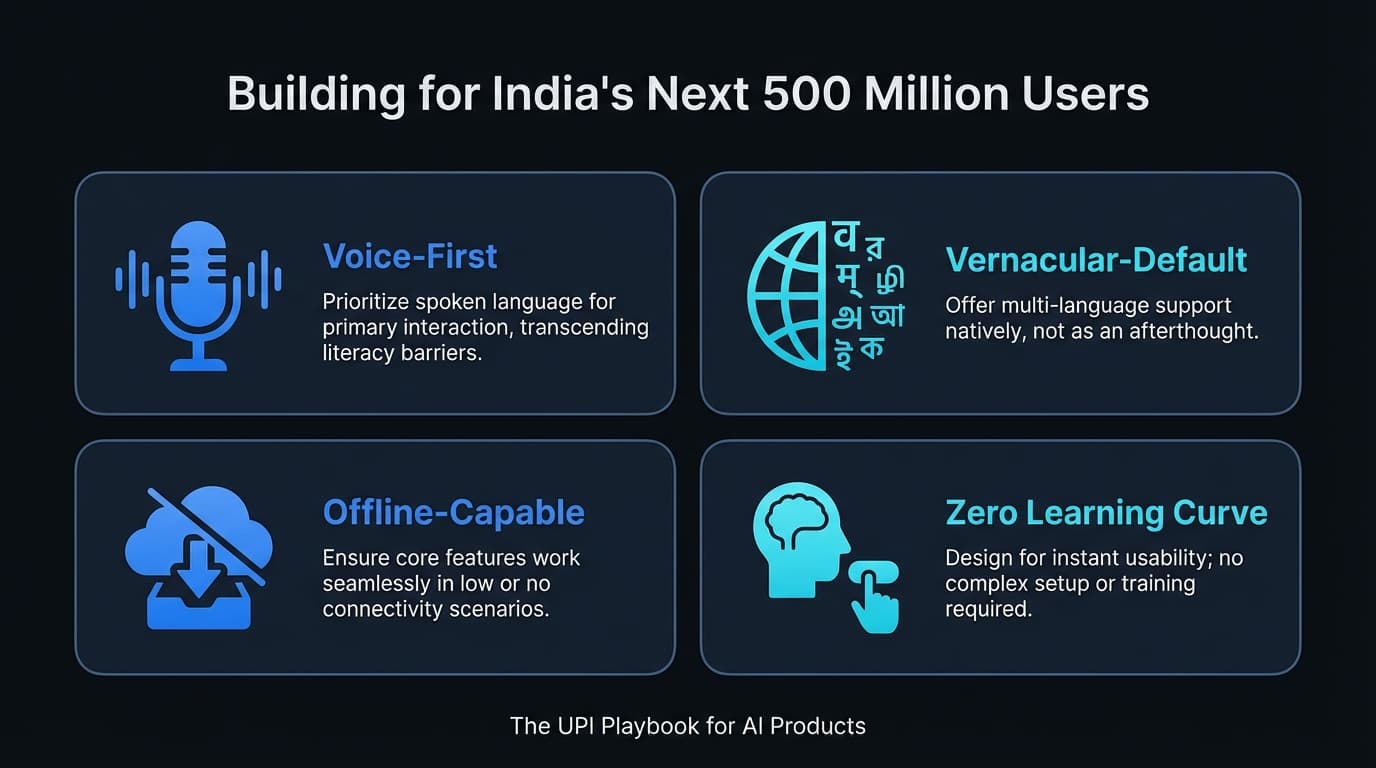 Design principles for building AI products that improve digital literacy in India
FAQ — Digital Literacy and AI Adoption in India
What is the digital literacy rate in India in 2026?
India's national digital literacy rate is approximately 37%, according to NASSCOM Foundation data. Urban areas show 61% digital literacy, while rural areas lag at 25%. The government's PMGDISHA programme has trained 6.39 crore people, but a significant gap remains between training completion and real-world digital confidence. Kerala became the first state to achieve 100% digital literacy in August 2025.
How can AI improve digital literacy in India?
AI bridges the digital literacy gap through voice-first interfaces, real-time language translation, and simplified UX. Platforms like Bhashini translate government services into 35+ Indian languages. Voice AI eliminates the typing barrier entirely. On-device AI from companies like Sarvam works offline in rural areas. Rather than training users to navigate complex systems, AI makes those systems adapt to users.
What is Bhashini and how does it help with language barriers?
Bhashini is the Indian government's AI-powered translation platform supporting 35+ languages through 1,600+ AI models. It processes 8-10 million translation calls daily and is integrated with 47 government portals including IRCTC and NPCI. Bhashini enables Indians to access government services, railway bookings, and financial tools in their own language instead of English.
Why did UPI succeed where other digital initiatives struggled?
UPI succeeded because of four design decisions: zero merchant charges removed economic friction, QR codes eliminated complex interfaces, the system worked without English proficiency, and UPI 123PAY extended payments to feature phones via IVR in 12 languages. Critically, UPI met users where they were instead of requiring them to learn new digital skills first.
How big is India's digital economy?
India's digital economy contributed 13.42% of GDP in 2024-25 and is projected to reach 20% by 2030, exceeding USD 1 trillion in value. The digital payments market alone is expected to grow from USD 3 trillion to USD 10 trillion by 2026. India handles 49% of global real-time digital transactions and ranks second globally in AI adoption at 57%.
The Path Forward for Digital Literacy in India
India does not have a technology problem. It has an adoption problem. The infrastructure — Aadhaar, Jan Dhan, UPI, BharatNet, 5G — is already world-class. The missing piece is making digital tools genuinely accessible to the 63% of Indians who remain digitally illiterate despite owning smartphones and having internet connections.
Three things must happen simultaneously. First, AI-powered vernacular interfaces need to become standard, not optional, across government and commercial platforms. Bhashini is a strong start, but it needs to reach every digital service in the country. Second, voice-first design must replace text-first design as the default interaction model for India. Third, product builders need to stop designing for Bangalore and start designing for Bhagalpur.
UPI's success is the clearest proof that India can achieve mass-scale digital adoption when the design is right. The same principles — simplicity, zero cost, local language support, and public-private collaboration — can work for healthcare, education, governance, and commerce.
The stakes are high. India's digital economy is projected to contribute 20% of GDP by 2030. Getting the next 500 million Indians genuinely online — not just connected, but capable — will determine whether that projection becomes reality.
At Call O Buzz, we build AI solutions for real Indian users. Voice-first, vernacular-default, and designed for the India that exists beyond the tech hubs. If you are working on products for India's underserved digital population, we should talk.
Check out our AI-powered SaaS products, explore our open-source contributions, or read how AI is reshaping SaaS development in 2026.
Ready to build AI that works for all of India? Get in touch with us.
SV
Founder & CTO, Call O Buzz Services